

Finally all the hard work has paid off. At the beginning of this week we heard back from the Department of Agriculture regarding the milk sample we supplied them. It passed all the required tests easily and we are therefore now an official dairy. Although this part of the state was thick with dairies many years ago they have all since closed and we are now the only licensed dairy in Douglas County, and only the second current sheep dairy in Oregon.
This week we also had further enquiries regarding our milk, so come October when the lambing for this next season starts, we will have plenty of avenues for our milk.
Haying is all but done with just one last field to be baled. We should end up with around 300 bales which is a good 50 more than last year. The rain has finally stopped now and we should be in for a couple of months of fine clear skies. This weekend the dam goes in and as soon as the last hay bales are removed from the field I can start manure spreading. Busy time of the year, but in a month or so we will have the calm before the storm of lambing and milking.
Friday, July 2, 2010

Friday, June 18, 2010
Hey June.
With the weather finally breaking at the end of last week, we are now in the throes of haying. We have three fields to hay this year, the same ones we did last year but already it seems as though the grass in the top field is longer and thicker, meaning we should have a much higher yield than the 244 bales we managed last year. We'll be working in collaboration with our neighbor, the doctor. He will be using our cutter and our fluffer/rake and we will be using his round baler, although the smaller of the three fields will likely be done in square bales - the clover content is higher and the grass isn't as long, but the protein value looks better. Square bales are easier for me to feed the sheep with whereas the round bales are more along the lines of what people want to buy. Thankfully then we can produce both.
The inspectors from the Department of Ag returned on Tuesday and we now need only to supply them with a milk sample for our license. they'll be dropping by next Monday to pick up a sample, which means we have had to round up the 8-10 ewes that are still feeding their lambs and ensure they haven't fully dried up. This afternoon we milked them (and will do so once each day now so we can give the Dept Ag a milk sample) and were surprised at the volume we got. Even just a weeks worth of one milk session per day will provide us with several gallons of milk to make some more cheese in the coming weeks.
A couple of weeks ago we acquired a couple of pigs. They are both around 250 lbs so we are just putting a few more pounds on them before we have them slaughtered. Looking forward to lots of bacon, pork chops and a couple of good pork roasts. Marlowe can't understand why they don't fear him like the sheep do, and Byron just wants their ears!..
This weekend the last of the wethers will head to the scales and we will be left with our 70 ewes. We are also hoping that in between baling the back field we'll have time to paint the milk barn.
Friday, May 28, 2010
Forward into Summer
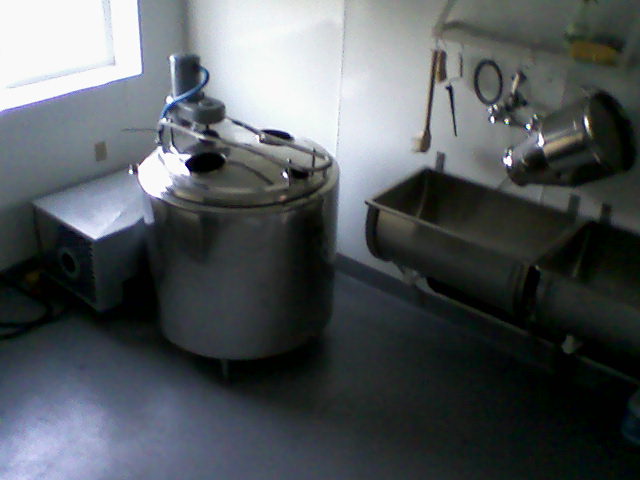
I can't believe it's been two months since my last post on the blog here. It's not like in that time we haven't been busy, far from it. In fact we are only a single step away from being a fully fledged licensed dairy. Several weeks ago we had the Dept of Ag Food and Safety people out here going over the facility with a fine tooth comb making sure that our facility was up to scratch and met all of the PMO (Pasteurized Milk Ordinance) guidelines. Along with the inspection came the news that we would likely be licensed within the month. Two very minor things needed fixing - the steps up from the milk room to the milking room needed sealing up the step wall and our milk urn into which the vacuum delivers the milk needed replacing with one that was PMO approved (which meant a high polish finish both inside and out). We sealed the steps the day after the inspectors left and our milk urn (Italian stainless steel) arrived at the beginning of the week. We now await the inspectors return and their granting of our license.
We have now dried off our last few ewes and have turned them back into the pasture with our two rams in order to ensure we maximize our efforts starting at the end of this year. All of our ewes, including our yearlings from last year's batch will start a new lambing cycle beginning October 6th (or there abouts). This time we will be going with the D1 procedure (meaning we will take the lambs from their mothers after 24 hours and raise them on formula/milk replacer) as this ensures a longer milking cycle and enables us to get the ewes starting at a high production level. We had found that the D30 technique wasn't as efficient as by that time some of the ewes had already started to slow in their production and could not produce as much milk as was expected.
The last few months have been spent doing a lot of research regarding markets for our milk.We still intend to make cheese with some of it, but we are in the process of finalizing our production procedures for another product. Once we have the graphics, etc in a first stage of completion I will reveal all. Suffice is to say this is a unique product on the market here so we have no competition.
Around the farm Will and I are beginning to remodel the old cow enclosures around the original cattle head gate. We have been using this corral to load the wethers into the trailer for the market and decided that with some work we could make it more useful on a day to day basis. In between the last spring rain showers all of the essential work has been done ready for the coming haying and we are pleased to see the farm at a point now where we are no longer catching up with maintenance and repairs but are seeing projects I had planned when we first got here starting to move forward. As I mentioned earlier we are going to be doing all of our haying ourselves this year. We're confident we can manage it and the benefit is that we keep all of the hay for ourselves and can make a bigger profit on what we don't need.

The other big news is that my mother is here for a three month holiday. I drove down to pick her up in San Francisco at the beginning of May. With the showery weather it's been tough getting the time to do things but now that appears to be breaking and we are making the most of the sunny weather. The above image is a sample of the beautiful Oregon landscape on the road out to Crater Lake.
In all things are going well at the moment, no mishaps or nightmare problems. Our six monthly inspection also happened at the end of April, and again we passed easily. In fact the field officer for the Dept of Ag brought along a small army of field reps from all over Oregon to see our operation, and despite the terrible weather, all were very impressed with what we had done.
Next weekend is the annual Lamb Show, a major event in our calendar, but we won't be showing any of our livestock, maybe next year. I'll be back with some pictures from the show next week.
Tuesday, March 16, 2010
One of 2009/2010's Success Stories
 One of the big success stories we have had over the last few months has been the effectiveness of the FootVax vaccine we used in September 2009 for the inevitable hoof rot problems we were to encounter over the winter. In order to ensure there were no serious problems, we vaccinated half the flock in September and kept the other group as a control. All sheep who at the time were known to have had the problem were included in the vaccinated group.
During the winter months, when the foot rot bacteria are most prevalent, particularly so in this part of Oregon, we only had 3 sheep displaying problems. All three were jugged and their hooves treated and bandaged. All three were from the control group that were not vaccinated. For the last two hoof trims all of our sheep have been clear. Some feet are still a little scarred from earlier bouts, but all sheep are free and clear of hoof rot problems. For any sheep farmer this is a great victory, but more so for this part of the country where hoof rot is a significant problem with almost every shepherd we speak to experiencing it regularly.
On another good note we have just started our second lambing group. 3 lambs born at the end of last week and several ewes ready to pop. Everything else moves along fairly smoothly. Over the weekend the hay equipment was taken out of the storage shed and moved to the main barn. I'm replacing the blades on the disc mower but converting the old square baler from wire to twine isn't going to happen alas, the cost is just not worth it according to the local New Holland dealership where they do that. Cheaper just to buy a second hand twine one and use mine as a spare parts one. Have to think on that one as acquiring another would likely mean a trip into either Idaho or Washington as they are thin on the ground here in Oregon.
If the old beast can hold up, which there's no reason to believe she can't, then we will be doing our own haying this year. It will likely take us a while, but it's more profit for us. Square bales stack easier than round ones as well and are a lot easier to move around. At the very least I can cut the hay and rake it myself and get someone else in to bale if need be.
Our calf leaves us this week. She's 10 months old now and as big as her mother. We have sold her to the guy we buy our orchard grass/alfalfa from and got what we think is a very reasonable price for her.
On other miscellaneous news, yesterday we had engineers looking over the bridge outside once again. Apparently the design is now out for bid which means that we should have a new bridge going up in the next few months. Interesting times ahead on that.
Tuesday, February 16, 2010
A Milking Update
 It has been two weeks since we started milking and so far everything has been running relatively smoothly. We seem to have got most of the routine down to a set time give or take a few minutes depending on how the sheep are behaving. We have a couple who are problem animals. They don't like being touched on the insides of their back legs so it makes moving their legs to clean their teats interesting to say the least. I've only been covered in iodine once, not bad really all things considered.
Over the weekend Will and I built a ramp from the main barn into the milking lane just in front of the actual entry to the milking barn. It means we have the ability to properly separate the two flocks of sheep without having to resort to pasture rotation acrobatics or the moving of sheep and the closing of multiple gates. Luring them in with pea pellets certainly help and they only need to do something a couple of times before they learn. That's one good thing about sheep, they're such good....sheep.
So we've been recording milk temperatures as well to make sure we comply with the PMO (Pasteurized Milk Ordinance) which is like the milk producers bible and is what we had to ensure all our construction plans adhered to when building. We are required to reduce the temperature to a certain level in a certain amount of time (50 F or 7 C or less within 2 hours of the completion of milking). We're freezing the milk, but a regular fridge/freezer or chest freezer doesn't have the capacity to lower the temperature fast enough, hence our purchase last year of the laboratory freezer.
On a personal level I am looking forward to the time when we can shear the sheep and the wet weather ends. Cleaning them at the moment before milking is the biggest chore.
This week we plan on starting to make some cheese finally. We're producing enough milk on a daily basis now so its just a question of exactly where we are going to go with the cheese. We have already got a list of maybe a dozen we are going to experiment with, but there are a core 3-4 we want to concentrate on. One of the lessons I have learned from other cheesemakers is that you should choose a small number to use as your starting point rather than trying to produce lots of different varieties. Only selecting a few means we can perfect the process quicker.
Wednesday, February 3, 2010
D-Day Arrives
Well today was an interesting day in more ways than one. But, at the end of the day we are happy to announce that everything was a success. Over the last few months we have done hundreds of calculations based on every possible variation in volume, dollar value for raw milk, laction periods, the whole nine yards. This is all done as well based on a 10/14 milking cycle. Oh the intricacies of running a dairy!
The volumes we got today are inside our minimum maximum window which means extrapolated out we will earn more than our minimum but less than our maximum assuming a price of $75 per hundred weight and the milking of 100 sheep. Of course we aren't milking that many ewes and won't be until next year at the earliest (we will have a maximum of 46 over the course of this year), but it does show that everything we have been working towards is rock solid.
Well my apologies if I have completely bored you or lost you dear reader, but this is a major step forward for us and we are very happy. For your viewing pleasure and patience here is another gratuitous lambiness photo.

Tuesday, February 2, 2010
T-1 and Counting
Tomorrow we start milking properly. By that I mean no more dry runs, practice runs, one sheep at a time runs or any other type of runs. Tomorrow it's 4 sheep, then the next 4 sheep until we're done and with each week from now until the end of the lambing we will be adding new ewes to the group once their lambs are 30 days old.
We have everything ready to go, we couldn't be more prepared if we tried. Last thing in place was a new stainless steel workbench for the milk room so we have somewhere to fill the bags for freezing. How much milk exactly we expect tomorrow is still something of an unknown variable and considering that volume is really what determines viability, it's hard not knowing. Sure we've done tests with single sheep, but they're all different, that's the factor that at the end of the season determines who we keep and who we say goodbye to. That's not the only factor for sure but it's a big one.
Lambing has been going well. We had one bad day last week where we lost 3 lambs. Their mother just wasn't feeding them andno matter how hard we tried, even down to feeding tubes in the stomachs, they just didn't have the will to live. All were incredibly small when they were born. Their mother's know by instinct, it's uncanny, the ones that won't survive get left. It's nature's way. It's still hard coming to terms with the fact that you just can't save some.
No problem with these little ones though, they are all at the stage now where they are running around like crazy.
 So the time is coming. Tomorrow I should have a post reflecting on the first day of 'official' milking. Stay tuned!
Sunday, December 27, 2009
First Lambs of 2009 / 2010
 This morning the first of our lambs was born for the coming season. The mother was one of our Hampshire/Dorset ewes that was born soon after we arrived on the farm in February 2008. This makes it the second generation we have witnessed being born here. The lamb was a boy, a single birth but a very healthy looking little fellow.
Monday, December 14, 2009
Appearing Soon: New Lambs!!
Over the last week we have been busy putting the finishing touches to the jugs and the lamb pen for the pending arrival of the new batch of lambs. If our records are correct the first ones will be born on Wednesday (16th December) - although this date is based on when the ram was turned in with the ewes so in all likelihood it will be a few days past that - also the ewes are first time mothers. Things have gone a lot smoother in preparation this time and we knew exactly what we needed to do and how best to change things to suit us.

The weather has been particularly brutal in the last few days. Temperatures got down to 10 F (-12 C) and all the water troughs froze and we had a couple of burst water pipes outside the barn - thankfully no problems with the new dairy piping. Considering that the weather has been called unusually cold by the locals I think that's a testament to the builders and our design! Unfortunately we did lose a ewe lamb from this years March/April crop. She was the smallest and just didn't have enough in her to overcome the chill. By all accounts we have been fortunate once again.

For those interested in a more comprehensive photo diary I am going to update the actual web site - Catesby Farms over the next few days so you can see the complete evolution of the milk barn.
Monday, November 30, 2009
Finishing Touches
Over the weekend the last few things needed to complete the dairy were done. We just need to go in there this week and give the place a really good clean.
The refrigerated tank arrived and we had a refrigeration technician disconnect it so we could move it, then once in place it was reconnected, serviced and tested. Everything works fine. Moving the tank was made easier (it weighed around 850lbs) when we realized it could be taken through the main door with barely a 1/16 of an inch to spare either side. Same thing with the freezer we had in the garage - it just made it through.
 In the actual milking area the stanchions came back from the powder coaters looking fantastic and with a bit of concrete drilling everything was fairly easy to anchor to the floor and install. The double set of head gates will enable us to milk 8 sheep at a time with there being enough room to install a third unit to increase our capacity to 12 in the future as the flock grows. At present, we will be milking 7 groups of sheep. At 10 minutes a group, that should take us about 90 minutes per milking session taking into account prep and clean-up either side. Time will prove us right or wrong.
 Over the last few weeks all of the ancillary items from sterile wash cloths to overalls and boots have been slowly arriving as well. We've assembled a small stainless steel trolley, shelves, a wash system, and now just have the pit to paint and the cleaning to do before we call on the Department of Agriculture to come out and give us an inspection. We should have the green light days before the first lambs are due for the next season so our timing is right on the money.
November, being the wettest month of the year usually has seen the lagoon fill fairly quickly. We pumped this year in January and August but will likely pump this week (on account of the pending clear skies - clear of further rain that is). Once emptied it will take the rest of winter and spring to fill before we empty it again in summer although we have to take into account the wash water from the dairy now so maybe we will be pumping again in spring. With the new flexible irripod hoses and irrigation pods this should be a much smoother operation and not involve the on-going moving of aluminimum pipes (which in winter when its freezing cold becomes a real task!). The flexibility allows us to irrigate at least 4 of our fields now without any issues whereas this year with the restriction of the aluminium pipes we could only irrigate 2. With a bit of magic we can probably do almost all of the property from this set-up if we needed.
 The dogs of course are loving the weather. As for the inside of the house, it's also moving ahead really quickly. All the wet weather has meant we have had a lot more time inside to work on putting up trim and painting. It seems to be a neverending job, but the house is finally looking warm and comfortable, rather than how it originally looked - white, cold and sterile.
The refrigerated tank arrived and we had a refrigeration technician disconnect it so we could move it, then once in place it was reconnected, serviced and tested. Everything works fine. Moving the tank was made easier (it weighed around 850lbs) when we realized it could be taken through the main door with barely a 1/16 of an inch to spare either side. Same thing with the freezer we had in the garage - it just made it through.
 In the actual milking area the stanchions came back from the powder coaters looking fantastic and with a bit of concrete drilling everything was fairly easy to anchor to the floor and install. The double set of head gates will enable us to milk 8 sheep at a time with there being enough room to install a third unit to increase our capacity to 12 in the future as the flock grows. At present, we will be milking 7 groups of sheep. At 10 minutes a group, that should take us about 90 minutes per milking session taking into account prep and clean-up either side. Time will prove us right or wrong.
 Over the last few weeks all of the ancillary items from sterile wash cloths to overalls and boots have been slowly arriving as well. We've assembled a small stainless steel trolley, shelves, a wash system, and now just have the pit to paint and the cleaning to do before we call on the Department of Agriculture to come out and give us an inspection. We should have the green light days before the first lambs are due for the next season so our timing is right on the money.
November, being the wettest month of the year usually has seen the lagoon fill fairly quickly. We pumped this year in January and August but will likely pump this week (on account of the pending clear skies - clear of further rain that is). Once emptied it will take the rest of winter and spring to fill before we empty it again in summer although we have to take into account the wash water from the dairy now so maybe we will be pumping again in spring. With the new flexible irripod hoses and irrigation pods this should be a much smoother operation and not involve the on-going moving of aluminimum pipes (which in winter when its freezing cold becomes a real task!). The flexibility allows us to irrigate at least 4 of our fields now without any issues whereas this year with the restriction of the aluminium pipes we could only irrigate 2. With a bit of magic we can probably do almost all of the property from this set-up if we needed.
 The dogs of course are loving the weather. As for the inside of the house, it's also moving ahead really quickly. All the wet weather has meant we have had a lot more time inside to work on putting up trim and painting. It seems to be a neverending job, but the house is finally looking warm and comfortable, rather than how it originally looked - white, cold and sterile.
Thursday, November 19, 2009
The Catesby Farms Dairy Almost Online
With just the milking stanchions left to install, the bulk milk tank to be moved into place and primed with Freon, and the freezer to be moved, the Catesby Farms Dairy is on the verge of getting the green light. Once the last three details are completed, sometime mid next week, we will arrange for the Oregon Department of Agriculture to come and inspect us. Assuming we pass, we will be a legitimate dairy operation!
Here are a couple of pictures of how the interior looks right now, post-renovation. Once the milk tank is installed and the freezer is moved I will put some more pictures up. The outside still needs a good coat of paint but that will wait until the warmer months next year.

 In other news, we are on top of everything else that needs doing around the place, which we think is a first. The hay is slowly going out the door, a half dozen bales a week and both the Bobcat and the Hyster are now back in operation after breakdowns. Most of the ewes are now pregnant, with the first ones ready to lamb mid December. We shall be taking the ram out of the field in about 10 days and then selling the last remaining wethers.
All the work left to do around the place is small - cleaning the machinery shed is probably the largest job still to do. It feels good to be on top of things at last.
Wednesday, October 28, 2009
Time Goes By Quickly
It's been 2 months since I updated the blog, and a lot has happened in that time. Not only have we had visitors from Australia, but the milk barn is now 99% completed and the rains have finally arrived.
In the video above are our two main dogs Marlowe and Byron. Marlowe is the frisbee addict and Byron if you remember was the dog I took to Canada twice to have both his hips replaced. Hard to tell that a year ago he was a virtual cripple. Now he hares around the place like there was never anything wrong.
The nights are starting to get quite cold and the whole place feels as though its falling slowly into sleep mode.
Our first group of lambs for the new facility are due to be born early December. This will be a test group of ewes so that we can get all our automatic milking processes perfected before the bulk of the lambs arrive mid March. If all goes according to plan we will have between 60 and 70 ewes lambing.
The final clean-up before the winter sets in has been temporarily placed on hold while the hydraulic pump on the bobcat is repaired. Alas it isn't a simple, or cheap job and I'm really missing it at the moment as there is still manure to spread and feedlots to scrape.
The farm itself though is in the best shape its been in for many years. All of the fencing is now repaired or replaced where needed, we have spread new pasture grass in one of the paddocks and we are feeling a lot more comfortable with how everything should be as we head into our third winter here.
We recently had some visitors from Australia. Friends of the family that were passing through on a mammoth road trip across America. It seemed strange to hear Australian accents again.
Last weekend the wethers went to the scales. We had 21 this year. In a couple of weeks we will likely thin our ram numbers as well with another 5-6 off to the scales.
One thing we have been using (and so far the results look promising) is a footrot vaccine. Footrot is one of the more common problems with sheep in this part of the country. The bacteria that cause it live in the soil and its almost impossible to get rid of. It thrives in the cold and wet so lies dormant most of summer and then hits hard in Fall or Spring. We treated a couple of ewes with it recently but everyone else looks to be doing well so we are keeping fingers crossed that the vaccine works. Apparently the local vet did all the clinical and field tests in the region, but general reports nationally are mixed about its effectiveness. So far we seem to be going well.
Hopefully I can be more punctual with the next update.
Tuesday, August 25, 2009
Sheep Dog Trials
Over the weekend we attended a local Sheep Dog event held by a friend of ours. The Colliding Rivers event was this year being used as a warm-up event for the National Sheep dog Trials being held here in Oregon at Klamath Falls in late September.
Sheep dog trialing is a lot different in Oregon than it is in Arizona where Jen first started doing it. Back there you run your dogs in a small arena-like enclosure, but here in Oregon the courses are large, covering dozens of acres and include hills, valleys and of course a lot more obstacles. The comparison is like show jumping and cross-country with horses.
Over the last few days we have started bringing Hamish, our youngest dog up to the fields so he can have a run around with the sheep. Marlowe is already well versed in the intricacies of sheep handling and Byron has been back on the sheep for a few months now since he was given the all-clear after his double hip surgery. It's fascinating to watch them. You can see them thinking about what they are doing and just like people each has their own personality and of course methodology. Marlowe has drive and determination and his concentration is unequalled. Byron can balance the sheep perfectly, and Hamish seems to have the enthusiasm of Marlowe. We have high hopes for him as he is a relative of the dog that came 5th in the UK Nationals last year, and descended from a line that has won that title on more than one occasion.
We'll be heading down to Klamath Falls overnight when the Nationals begin and hopefully we'll pick up a few more pointers, but it will also be an opportunity to meet up with some of our Arizona friends who got us started in this all those years ago.
Monday, August 3, 2009
Rest in Peace, Bandit

This morning, before the sun had fully risen into a glorious clear blue sky, we buried Bandit under an apple tree, here on Catesby Farms. In all my life I have never known a dog to have had such a long and eventful life as she did. When the body was no longer willing, nobody told Bandit she had to stop, so she didn't. Just yesterday she was walking around the back yard barking at the other dogs, keeping them in line and telling them what she thought, as she always did.
She lived a long and happy 18 years and experienced more than most dogs ever will. Having lots of other dogs around kept her young at heart and gave her the determination to keep going. She lived out the final year or more of her life as a farm dog, as all good dogs should, and now will always be a part of the farm, keeping an eye on the sheep and watching over us.
Wednesday, July 29, 2009
Is it hot enough for you?
The thermometer climbed to 108F for the scond day in a row today. The Pacific Northwest is apparently experiencing a heatwave unlike anything its experienced ever before, not since records were first taken. That makes doing a lot of the work around the place almost unbearably difficult. It also means that we have changed to night time irrigation in an effort to reduce the amout of evaporation happening and thus get more value out of the process.
I feel sorry for the contractors working on the Milk Barn, although they are here at 6.30am and gone by 3.00pm just as the temperature hits 100. They have made excellent progress so far. the new floor slab has been poured and all of the drain plumbing is now in place. Next will be the framing inside and then they will be running the electrical and sink plumbing through the walls. Everything so far looks really good.
I've started to clean out the main loafing barn as well as the jugs, in preparation for the lambing at the end of the year. All the jugs are empty now and I'll need to put some lime down to clear up anything nasty. In a month or two I will lay some straw and everything there will be ready to go. I might be able to do some work on the other end of the barn after that and get it ready for the lambs as a small nursery.
UPDATE: Overnight (29th/30th July) we lost one of our ewes due to the heat. I have been reading that a lot of northwest farmers have lost livestock due to the oppressive heat in the last week. We consider ourselves fortunate that we have plenty of undercover areas and the sheep have access to plenty of fresh water. Unfortunately sometimes you have to take the bad with the good and that's certainly the case when an animal dies. RIP #1134.
Tuesday, July 21, 2009
Today is.....Shopping Day!
The Milk Barn is now underway at long last. We have had contrators gutting and rebuilding it from the inside out since last week. So far they have redesigned the milking pit, laid all the foundation concrete and taken all the old walls and ceiling materials away. We also have a 'soon to be door' opening between the actual milking area and the two front rooms.
What does all this mean? Well it means we have finally placed the order for all our milking stanchions and our sinks and an electric water blaster that runs hot/cold off the mains. My one day a week ranch hand is a welder by profession and we are going to get him to assemble them into a solid rig as well as add a couple of things to the milking stand we will find useful, such as a quick release for the stanchions that can be operated from within the pit. Once the building is done, we can ramset the milking platform into the new floor.
Our ram 'Mr. T' is in with the younger sheep we got from Vermont Shepherd, which are now over 18 months of age. This means that we will be setup and ready to milk in early December with a second group of ewes lambing in early March as per this year. We are still undecided if at first we will sell the milk in raw liquid form (requires a bulk tank and compressor to cool it for the milk barn) or whether we will freeze it and sell it frozen. the latter would certainly provide us with a broader market as we could sell it interstate to other cheesemakers.
The irrigation is working well. The Irripods are easy to install and reduce the labour of moving pipes as well as providing a flexibility of moving around that the aluminium pipes don't give. It takes me about 15 minutes in the mornings to take the ATV out and shift them. The grass in the front field as well as the field with the irripods is looking really good at the moment, whereas the surrounding properties are all brown and the grass is dormant, thanks to the summer highs of 95 degrees (33 centigrade) we have been experiencing over the last few weeks.
At the end of last week we discovered in one of our old sheds a kitten that had been abandoned by its mother. Poor little thing is only about 4 weeks old, so we have been feeding it and it now seems to be doing well. It's a cute little black ball of fur at the moment, possibly a Coon Cat that will be good to keep the mice down in the barns when it's older.

Sunday, July 5, 2009
The Irrigation Jigsaw Puzzle
With the end of the haying for this year we are back into laying out the irrigation system. Last year, being our first experience, there were several issues that required major work, from buying a new 5HP pump to determining the best layout of pipes to irrigate maximum land. All that took time and unfortunately because of that and other tasks we were undertaking at the time we were unable to get a second hay cutting on any of our fields. This year things will be different.
Last year we had someone helping us hay, this year we had the same person, but next year we are planning on doing the whole thing ourselves. I bailed the front field using our old New Holland Hayliner, and after a few disasterous results we managed to get a good yield of 110 bales. The irrigation is now on that field so we will get another cutting come late August I am hoping and if the weather is good a third is not out of the question.
 Beyond that we have 2 other fields that are being worked on. Moving the 5HP pump to the river side and connecting up the 6" mainline we will be able to irrigate both of them. The smaller will hopefully net us about 200 square bales in a second cutting. All of this is good news because our actual hay consumption in winter is small, meaning that all of the hay we have just cut can be sold - which amounts to about 120 round bales (that sell for about $20 each). As I mentioned because of the lack of rain this year during spring, this season will be a lean one for hay so we will keep ours undercover for a few months and anticipate the price going up.
 In order to get a lot of the work done around the place - work that requires two men, I have found myself a farmhand for one day a week. He's been helping now for a couple of weeks and we've already made spectacular progress rebuilding a couple of our fences. I'm hoping that by winter we will have done most of the renovation work around the farm, from the fencing to reseeding a couple of the fields (they're full of foxtail, but that's another story!).
 One important piece of news, our cow finally had her calf, a heifer, and she's very sweet. she's already bigger than the ewes so even at 2 weeks of age she's bossing them around.
In a weeks time we put our ram in with the lambs we got last year. They are now about 20 months of age so ready to start producing. This means that we will be lambing in November and then again next March/April. We have a dozen that will lamb at the end of the year assuming all goes well and this will be a good lead into a full milking schedule for next year. By April we will have ironed out all our issues and will be milking around 50 ewes.
We are waiting on the contractor to give us a start date on the renovation of the milk barn. after going through the new plans, the renovation plans and various permutations, we have a list of what needs doing and what needs buying. The hard work there will also be done by the time we lamb/milk in November.
Note: Someone requested more pictures, so I will attempt to add more in each post.
Tuesday, June 9, 2009
Summer is on its way, at last.
It's been an odd Spring. It has been a lot dryer than normal, and all of the rainfall figures for Douglas County from January to April are at about 2/3 of the average. What that translates to is a leaner hay season, which started a couple of weeks ago for most people on Memorial Day weekend. Ours started last week, earlier than last year but a sudden thunderstorm stopped everything in its tracks. The ground has dried at last and we're back in the swing of things.
The lambs are all doing very well, most are over the 50lb threshold now and the earliest ones are looking almost as big as last years yearlings. they're all on pasture now and have been for over a month, which has enabled us to determine our hay usage over the winter and so we know from the cut happening now how much we will need for the winter ahead. The rest can be sold, and if we can get a second cutting from at least 2 of the fields we should make a decent profit, at least enough to get the hay equipment we own working 100% so we can do our own hay next year and take all the profits.
With the lagoon in place we have an extra 40,000 gallons of 'water' that we can use for irrigation, with the added bonus that it has manure in it which is great for fertilizing the grass. Once the haying is done we will begin irrigating, and hopefully will get a second cut in late September.
The ewes were all shorn last week and we are about to turn them all into the neighbours fields for a couple of months once he has removed his hay. That will take the pressure off our pastures and allow us to do some serious fencing work, making some of the larger pastures smaller to aid in flock rotation.
Late last month we had some Arizona friends stay with us for just over a week. We had been feeling jaded because of the work we still have ahead of us but they picked us up and have given us a new perspective. The rebuild plans for the milk barn have halted, the quotes we received were a little higher than we had anticipated, even in the economic climate we're in, so we are moving ahead slower than we originally anticipated, but that is good in some degree because we are not feeling out of our depth, as we had felt now and then before. The milk barn has been gutted and over the summer months Jen and I will try and renovate as much as we can ourselves.
We have some new ideas we are looking into, thanks to our Arizona friends, including selling raw mutton from our culls as dog food. Looking at the prices around it should be more profitable than just sending them to slaughter.
At the moment we are handicapped by the fact our Bobcat isn't working. Once its back in one piece and the haying is done and the irrigation is running, I have to use the manure spreader to spread about 3-4 tons of solid manure across our 50 acres. That should be fun! Actually its not that hard a job, it just takes time, like everything.
We are also about to turn our young unproven ram in with about a dozen yearlings so we have some lambs in Autumn. these ewes will hopefully be the first small group that we milk on a regular basis. as I mentioned, moving slower is a lot more comfortable.
Sunday, April 19, 2009
Urbanites Opting for Simpler Lifestyle
Over the last few days (thanks to a USA Today article) I have taken the time to notice that there seems to be a lot of movement of urbanites like ourselves back to the land. While most seem to have been forced as a result of the economic collapse that now seems to be happening pretty much right across the globe, this surely is a good thing. All of the blogs, articles and even Facebook pages that I have been going through are filled with people that despite some rude shocks and a general unpreparedness for their new lifestyle are actually happier, and more balanced people for having made the change.
As I have mentioned before I have urbanite friends in Canada who want nothing more than to be able to buy a couple of hundred acres, build themselves a green home, and raise livestock. They are like a lot of others I am reading about - those who at present are unable to move and so are turning their once dormant back yards into vegetable producing gardens. Even in the UK it seems this revolution is happening with companies reporting enormous increases in seed sales.
Will it last? That's certainly an interesting question. Once economic stability arrives, will these people return to their urban roots and take up where they left off? I don't think so personally. I think that over time the growing trend will be to ruralization rather than urbanization. With the availability of mass communication and the internet these days there is no general need for the average person to be forced into the concrete jungles. All of the people I am reading about have everything they need and are living a more satisfying existence on sustainable plots of land. I know it's not for all of you, you're more than happy in the urban sprawl, and that's just fine as well.
I'd like to show my support for those people who have shown the courage (whether through economic necessity or not) to return to the land and a more satisfying way of life and for anyone out there interested in looking into it, take a look at some of these links:
Self-Sufficiency and Homesteading
Homestead.org
Mother Earth News
The Simple Living Network
When the Catesby Farms website is eventually launched (and yes I know that's been coming for months now), I'd like to include a small section on sustainable living, based of course on our own experiences. Maybe it will give you a better insight into how we are doing this, and maybe, just maybe it might tempt you to look further into it yourself.
Wednesday, April 15, 2009
Construction Time Again
Things have been busy with engineers, contractors and friends all doing their part for the Milk Barn project in the last couple of weeks. We have just had all of the original milking stanchions for the 6x6 herringbone cut out and the room is now empty apart from the pit in the middle. We have had various quotes for everything from a complete knock-down and rebuild to a renovation and a refit.
So, in the next couple of weeks we hope to have workers on-site renovating the Milk Barn and turning it back into a milking facility once again. Once that is done we will definitely feel as though we are getting somewhere. We have been looking at various milking systems and are having DeLaval come down from Salem to talk to us in the next few days. I am also in the process of talking to potential buyers of our milk. Initially we will not be able to use all we produce in our first foray into actual raw milk cheesemaking and as the flock grows next year and into 2011 (we are now aiming for 150 ewes) we will have a large surplus of milk that we will need to market. For the time being we want to get comfortable with the milking process in conjunction with the animal husbandry. Jumping into everything at once is never a good idea. Our initial figure projections show that milking 50 ewes next year will turn us a small profit and that we should be able to increase the flock to 100 ewes and then 150.
We realized we were overly ambitious with our initial plans considering there was so much to learn with regard to sheep management, animal husbandry, milking and of course cheesemaking. The first two are an on-going thing and you are always learning something new, the last one is a rewarding process but in order to be successful at it you need to know the three steps before it, and so milking is next.
The lambs are doing extremely well and all are putting on weight and looking very healthy. The differences between the three breeds is now starting to become more evident in their little faces and soon we will be starting to wean them. In the coming weeks we have the haying to look forward to as well. The rain and the warm weather that has started to grace us has kicked the growth season off and it's hard to believe that we only have another 6 weeks before we're haying again. The warm weather will be a welcome break from the particularly wet few months we have just had and will give us the opportunity to finish the vegetable planting for this year.
Subscribe to:
Posts (Atom)