Showing posts with label Milk Barn Renovation. Show all posts

Monday, November 30, 2009

Finishing Touches

Over the weekend the last few things needed to complete the dairy were done. We just need to go in there this week and give the place a really good clean.

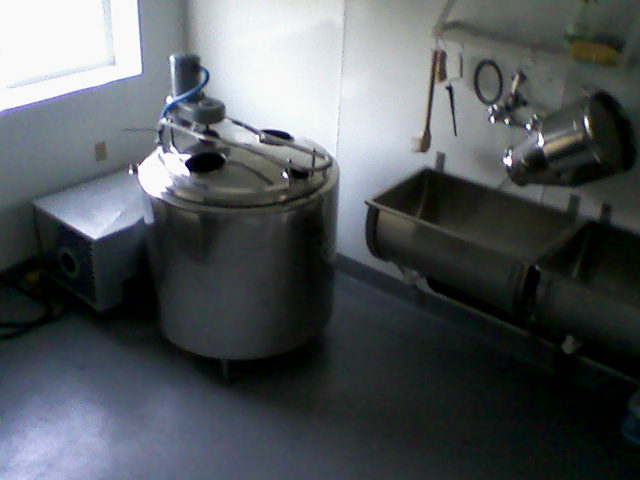
The refrigerated tank arrived and we had a refrigeration technician disconnect it so we could move it, then once in place it was reconnected, serviced and tested. Everything works fine. Moving the tank was made easier (it weighed around 850lbs) when we realized it could be taken through the main door with barely a 1/16 of an inch to spare either side. Same thing with the freezer we had in the garage - it just made it through.
In the actual milking area the stanchions came back from the powder coaters looking fantastic and with a bit of concrete drilling everything was fairly easy to anchor to the floor and install. The double set of head gates will enable us to milk 8 sheep at a time with there being enough room to install a third unit to increase our capacity to 12 in the future as the flock grows. At present, we will be milking 7 groups of sheep. At 10 minutes a group, that should take us about 90 minutes per milking session taking into account prep and clean-up either side. Time will prove us right or wrong.

Over the last few weeks all of the ancillary items from sterile wash cloths to overalls and boots have been slowly arriving as well. We've assembled a small stainless steel trolley, shelves, a wash system, and now just have the pit to paint and the cleaning to do before we call on the Department of Agriculture to come out and give us an inspection. We should have the green light days before the first lambs are due for the next season so our timing is right on the money.

November, being the wettest month of the year usually has seen the lagoon fill fairly quickly. We pumped this year in January and August but will likely pump this week (on account of the pending clear skies - clear of further rain that is). Once emptied it will take the rest of winter and spring to fill before we empty it again in summer although we have to take into account the wash water from the dairy now so maybe we will be pumping again in spring. With the new flexible irripod hoses and irrigation pods this should be a much smoother operation and not involve the on-going moving of aluminimum pipes (which in winter when its freezing cold becomes a real task!). The flexibility allows us to irrigate at least 4 of our fields now without any issues whereas this year with the restriction of the aluminium pipes we could only irrigate 2. With a bit of magic we can probably do almost all of the property from this set-up if we needed.

The dogs of course are loving the weather. As for the inside of the house, it's also moving ahead really quickly. All the wet weather has meant we have had a lot more time inside to work on putting up trim and painting. It seems to be a neverending job, but the house is finally looking warm and comfortable, rather than how it originally looked - white, cold and sterile.

Thursday, November 19, 2009

The Catesby Farms Dairy Almost Online

With just the milking stanchions left to install, the bulk milk tank to be moved into place and primed with Freon, and the freezer to be moved, the Catesby Farms Dairy is on the verge of getting the green light. Once the last three details are completed, sometime mid next week, we will arrange for the Oregon Department of Agriculture to come and inspect us. Assuming we pass, we will be a legitimate dairy operation!

Here are a couple of pictures of how the interior looks right now, post-renovation. Once the milk tank is installed and the freezer is moved I will put some more pictures up. The outside still needs a good coat of paint but that will wait until the warmer months next year.


In other news, we are on top of everything else that needs doing around the place, which we think is a first. The hay is slowly going out the door, a half dozen bales a week and both the Bobcat and the Hyster are now back in operation after breakdowns. Most of the ewes are now pregnant, with the first ones ready to lamb mid December. We shall be taking the ram out of the field in about 10 days and then selling the last remaining wethers.

All the work left to do around the place is small - cleaning the machinery shed is probably the largest job still to do. It feels good to be on top of things at last.

Tuesday, July 21, 2009

Today is.....Shopping Day!

The Milk Barn is now underway at long last. We have had contrators gutting and rebuilding it from the inside out since last week. So far they have redesigned the milking pit, laid all the foundation concrete and taken all the old walls and ceiling materials away. We also have a 'soon to be door' opening between the actual milking area and the two front rooms.

What does all this mean? Well it means we have finally placed the order for all our milking stanchions and our sinks and an electric water blaster that runs hot/cold off the mains. My one day a week ranch hand is a welder by profession and we are going to get him to assemble them into a solid rig as well as add a couple of things to the milking stand we will find useful, such as a quick release for the stanchions that can be operated from within the pit. Once the building is done, we can ramset the milking platform into the new floor.

Our ram 'Mr. T' is in with the younger sheep we got from Vermont Shepherd, which are now over 18 months of age. This means that we will be setup and ready to milk in early December with a second group of ewes lambing in early March as per this year. We are still undecided if at first we will sell the milk in raw liquid form (requires a bulk tank and compressor to cool it for the milk barn) or whether we will freeze it and sell it frozen. the latter would certainly provide us with a broader market as we could sell it interstate to other cheesemakers.

The irrigation is working well. The Irripods are easy to install and reduce the labour of moving pipes as well as providing a flexibility of moving around that the aluminium pipes don't give. It takes me about 15 minutes in the mornings to take the ATV out and shift them. The grass in the front field as well as the field with the irripods is looking really good at the moment, whereas the surrounding properties are all brown and the grass is dormant, thanks to the summer highs of 95 degrees (33 centigrade) we have been experiencing over the last few weeks.

At the end of last week we discovered in one of our old sheds a kitten that had been abandoned by its mother. Poor little thing is only about 4 weeks old, so we have been feeding it and it now seems to be doing well. It's a cute little black ball of fur at the moment, possibly a Coon Cat that will be good to keep the mice down in the barns when it's older.

Sunday, April 6, 2008

Milk Barn - The Internal Workings

I thought I'd begin the next stage of the renovation of the Milk Barn with a brief explanation here as to what is currently there, what we intend to do, and ultimately how we envision it looking when its done.

This is what we are faced with at the moment. Apart from the front 2 rooms (where the previous owner made honey), it hasn't been used for close on 25 years and was originally designed for cattle in a 5x5 herringbone configuration that could milk 10 cows simultaneously. All the original stanchions remain and much of the transport piping is still in place. The steel needs cutting out and the concrete herringbone over the pit needs to be redone so the pit is properly rectangular. Of course the entire ceiling needs replacing, new walls need constructing and the floor needs to be relayed (thankfully it appears that thr septic system piping is still working after all these years).

The above plan (click on the image for a larger picture) shows what the final layout will hopefully look like. We will be limiting our initial milking process to a maximum of 6 sheep simultaneously although the equipment we will be purchasing does allow for expansion by units of 2. Depending on the eventual size of our flock (yes we are still discussing it) and our production figures we may switch from bucket milking to a basic vacuum pipeline, but the bucket units themselves will be fully integratable into a vacuum system, so no additional costs other than constructing the pipeline and buying the vacuum pump are involved.

Saturday, April 5, 2008

The Milk Barn has a New Roof

As predicted we had four wonderful days of sun this week. The roofers from Hunts Roofing and Construction arrived early Monday and inside three days did a great job in removing the old tin roof and replacing it with a tar shingle that matches the house. The plumbers came back at last and installed all of the plumbing, so we now have water in the back barn and capped piping in the milk barn area.


The next stage is to get inside and gut the place by removing all of the old stanchions, the ceiling and the wall coverings, then to begin the process of firstly cleaning all of the studs and then changing the locations of the doors and windows. With that done we can look at outside covering.

Thursday we completed the second half of the flock check up. We actually managed to put everyone through the tilter this time thanks in no small part to the weather and the lessons we learned last weekend. So all the sheep are tagged and wormed, and all the lambs have now been given their vaccination booster. We intend to do the run through about every six weeks in order to check for things like hoof rot, but after Thursday we have a lot more confidence in our ability to get the job done in a single day.

We also heard from David Major at Vermont Shepherd. He will be personally delivering our 12 yearlings and 12 lambs in June, sometime after we have thinned our current flock to 20.

Thursday, March 20, 2008

The Milk Barn


This is the Milk Barn that will form the centerpiece to the farm in the years to come. As you can see it needs renovating badly, but everything is there that we need.

Eventually it will house the milking room, the cheese room, a bathroom, and an aging/storage room. Because it has to comply with strict state regulations for us to receive Grade A certification, we need to do more than just 'fix it up'. There is a septic system which is being evaluated next week and then we are getting an industrial hygienist in to determine exactly what will need to be addressed, before we get the Oregon Department of Agriculture in to assess our plans.

First item on the list of things to be done though is to re-roof. That's a certainty and we are getting quotes on that drawn up at the moment. Then we could be faced with reinstalling a new septic system, relaying the concrete floor according to the PMO (Pasteurization and Milk Ordinance) code, and block wall resealing. The actual internal timber framing and construction seems to be the easy part (maybe it's because that's the part we can do ourselves).

So, stay tuned for updates or follow the project on the Milk Barn Renovation links below.