Tuesday, March 16, 2010

One of 2009/2010's Success Stories

One of the big success stories we have had over the last few months has been the effectiveness of the FootVax vaccine we used in September 2009 for the inevitable hoof rot problems we were to encounter over the winter. In order to ensure there were no serious problems, we vaccinated half the flock in September and kept the other group as a control. All sheep who at the time were known to have had the problem were included in the vaccinated group.

During the winter months, when the foot rot bacteria are most prevalent, particularly so in this part of Oregon, we only had 3 sheep displaying problems. All three were jugged and their hooves treated and bandaged. All three were from the control group that were not vaccinated. For the last two hoof trims all of our sheep have been clear. Some feet are still a little scarred from earlier bouts, but all sheep are free and clear of hoof rot problems. For any sheep farmer this is a great victory, but more so for this part of the country where hoof rot is a significant problem with almost every shepherd we speak to experiencing it regularly.

On another good note we have just started our second lambing group. 3 lambs born at the end of last week and several ewes ready to pop. Everything else moves along fairly smoothly. Over the weekend the hay equipment was taken out of the storage shed and moved to the main barn. I'm replacing the blades on the disc mower but converting the old square baler from wire to twine isn't going to happen alas, the cost is just not worth it according to the local New Holland dealership where they do that. Cheaper just to buy a second hand twine one and use mine as a spare parts one. Have to think on that one as acquiring another would likely mean a trip into either Idaho or Washington as they are thin on the ground here in Oregon.

If the old beast can hold up, which there's no reason to believe she can't, then we will be doing our own haying this year. It will likely take us a while, but it's more profit for us. Square bales stack easier than round ones as well and are a lot easier to move around. At the very least I can cut the hay and rake it myself and get someone else in to bale if need be.

Our calf leaves us this week. She's 10 months old now and as big as her mother. We have sold her to the guy we buy our orchard grass/alfalfa from and got what we think is a very reasonable price for her.

On other miscellaneous news, yesterday we had engineers looking over the bridge outside once again. Apparently the design is now out for bid which means that we should have a new bridge going up in the next few months. Interesting times ahead on that.

Tuesday, February 16, 2010

A Milking Update


It has been two weeks since we started milking and so far everything has been running relatively smoothly. We seem to have got most of the routine down to a set time give or take a few minutes depending on how the sheep are behaving. We have a couple who are problem animals. They don't like being touched on the insides of their back legs so it makes moving their legs to clean their teats interesting to say the least. I've only been covered in iodine once, not bad really all things considered.

Over the weekend Will and I built a ramp from the main barn into the milking lane just in front of the actual entry to the milking barn. It means we have the ability to properly separate the two flocks of sheep without having to resort to pasture rotation acrobatics or the moving of sheep and the closing of multiple gates. Luring them in with pea pellets certainly help and they only need to do something a couple of times before they learn. That's one good thing about sheep, they're such good....sheep.

So we've been recording milk temperatures as well to make sure we comply with the PMO (Pasteurized Milk Ordinance) which is like the milk producers bible and is what we had to ensure all our construction plans adhered to when building. We are required to reduce the temperature to a certain level in a certain amount of time (50 F or 7 C or less within 2 hours of the completion of milking). We're freezing the milk, but a regular fridge/freezer or chest freezer doesn't have the capacity to lower the temperature fast enough, hence our purchase last year of the laboratory freezer.

On a personal level I am looking forward to the time when we can shear the sheep and the wet weather ends. Cleaning them at the moment before milking is the biggest chore.

This week we plan on starting to make some cheese finally. We're producing enough milk on a daily basis now so its just a question of exactly where we are going to go with the cheese. We have already got a list of maybe a dozen we are going to experiment with, but there are a core 3-4 we want to concentrate on. One of the lessons I have learned from other cheesemakers is that you should choose a small number to use as your starting point rather than trying to produce lots of different varieties. Only selecting a few means we can perfect the process quicker.

Wednesday, February 3, 2010

D-Day Arrives

Well today was an interesting day in more ways than one. But, at the end of the day we are happy to announce that everything was a success. Over the last few months we have done hundreds of calculations based on every possible variation in volume, dollar value for raw milk, laction periods, the whole nine yards. This is all done as well based on a 10/14 milking cycle. Oh the intricacies of running a dairy!

The volumes we got today are inside our minimum maximum window which means extrapolated out we will earn more than our minimum but less than our maximum assuming a price of $75 per hundred weight and the milking of 100 sheep. Of course we aren't milking that many ewes and won't be until next year at the earliest (we will have a maximum of 46 over the course of this year), but it does show that everything we have been working towards is rock solid.

Well my apologies if I have completely bored you or lost you dear reader, but this is a major step forward for us and we are very happy. For your viewing pleasure and patience here is another gratuitous lambiness photo.

Tuesday, February 2, 2010

T-1 and Counting

Tomorrow we start milking properly. By that I mean no more dry runs, practice runs, one sheep at a time runs or any other type of runs. Tomorrow it's 4 sheep, then the next 4 sheep until we're done and with each week from now until the end of the lambing we will be adding new ewes to the group once their lambs are 30 days old.

We have everything ready to go, we couldn't be more prepared if we tried. Last thing in place was a new stainless steel workbench for the milk room so we have somewhere to fill the bags for freezing. How much milk exactly we expect tomorrow is still something of an unknown variable and considering that volume is really what determines viability, it's hard not knowing. Sure we've done tests with single sheep, but they're all different, that's the factor that at the end of the season determines who we keep and who we say goodbye to. That's not the only factor for sure but it's a big one.

Lambing has been going well. We had one bad day last week where we lost 3 lambs. Their mother just wasn't feeding them andno matter how hard we tried, even down to feeding tubes in the stomachs, they just didn't have the will to live. All were incredibly small when they were born. Their mother's know by instinct, it's uncanny, the ones that won't survive get left. It's nature's way. It's still hard coming to terms with the fact that you just can't save some.

No problem with these little ones though, they are all at the stage now where they are running around like crazy.

So the time is coming. Tomorrow I should have a post reflecting on the first day of 'official' milking. Stay tuned!

Sunday, December 27, 2009

First Lambs of 2009 / 2010


This morning the first of our lambs was born for the coming season. The mother was one of our Hampshire/Dorset ewes that was born soon after we arrived on the farm in February 2008. This makes it the second generation we have witnessed being born here. The lamb was a boy, a single birth but a very healthy looking little fellow.

Monday, December 14, 2009

Appearing Soon: New Lambs!!

Over the last week we have been busy putting the finishing touches to the jugs and the lamb pen for the pending arrival of the new batch of lambs. If our records are correct the first ones will be born on Wednesday (16th December) - although this date is based on when the ram was turned in with the ewes so in all likelihood it will be a few days past that - also the ewes are first time mothers. Things have gone a lot smoother in preparation this time and we knew exactly what we needed to do and how best to change things to suit us.


The weather has been particularly brutal in the last few days. Temperatures got down to 10 F (-12 C) and all the water troughs froze and we had a couple of burst water pipes outside the barn - thankfully no problems with the new dairy piping. Considering that the weather has been called unusually cold by the locals I think that's a testament to the builders and our design! Unfortunately we did lose a ewe lamb from this years March/April crop. She was the smallest and just didn't have enough in her to overcome the chill. By all accounts we have been fortunate once again.


For those interested in a more comprehensive photo diary I am going to update the actual web site - Catesby Farms over the next few days so you can see the complete evolution of the milk barn.

Monday, November 30, 2009

Finishing Touches

Over the weekend the last few things needed to complete the dairy were done. We just need to go in there this week and give the place a really good clean.

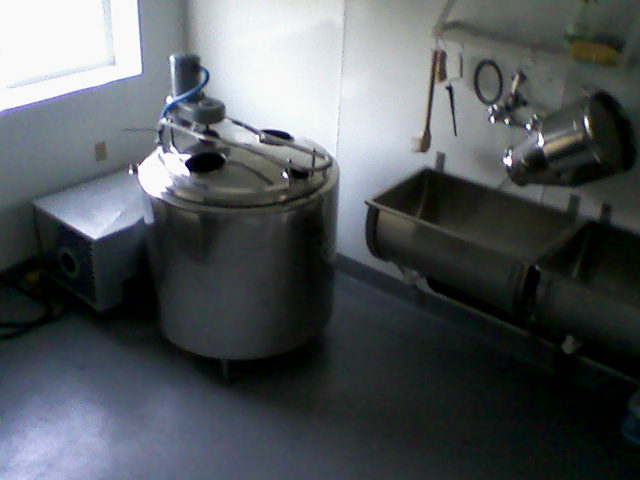
The refrigerated tank arrived and we had a refrigeration technician disconnect it so we could move it, then once in place it was reconnected, serviced and tested. Everything works fine. Moving the tank was made easier (it weighed around 850lbs) when we realized it could be taken through the main door with barely a 1/16 of an inch to spare either side. Same thing with the freezer we had in the garage - it just made it through.

In the actual milking area the stanchions came back from the powder coaters looking fantastic and with a bit of concrete drilling everything was fairly easy to anchor to the floor and install. The double set of head gates will enable us to milk 8 sheep at a time with there being enough room to install a third unit to increase our capacity to 12 in the future as the flock grows. At present, we will be milking 7 groups of sheep. At 10 minutes a group, that should take us about 90 minutes per milking session taking into account prep and clean-up either side. Time will prove us right or wrong.

Over the last few weeks all of the ancillary items from sterile wash cloths to overalls and boots have been slowly arriving as well. We've assembled a small stainless steel trolley, shelves, a wash system, and now just have the pit to paint and the cleaning to do before we call on the Department of Agriculture to come out and give us an inspection. We should have the green light days before the first lambs are due for the next season so our timing is right on the money.

November, being the wettest month of the year usually has seen the lagoon fill fairly quickly. We pumped this year in January and August but will likely pump this week (on account of the pending clear skies - clear of further rain that is). Once emptied it will take the rest of winter and spring to fill before we empty it again in summer although we have to take into account the wash water from the dairy now so maybe we will be pumping again in spring. With the new flexible irripod hoses and irrigation pods this should be a much smoother operation and not involve the on-going moving of aluminimum pipes (which in winter when its freezing cold becomes a real task!). The flexibility allows us to irrigate at least 4 of our fields now without any issues whereas this year with the restriction of the aluminium pipes we could only irrigate 2. With a bit of magic we can probably do almost all of the property from this set-up if we needed.

The dogs of course are loving the weather. As for the inside of the house, it's also moving ahead really quickly. All the wet weather has meant we have had a lot more time inside to work on putting up trim and painting. It seems to be a neverending job, but the house is finally looking warm and comfortable, rather than how it originally looked - white, cold and sterile.